
The Smallness of Human Life
La piel del tamborThis flow traces the novel’s movement from personal grief to astronomical scale and back to the value of brief human acts of care.
increasing Bearing strength in each event
 decreasing
Bearing strength in each eventdecreasingA Childhood at the Breakwater
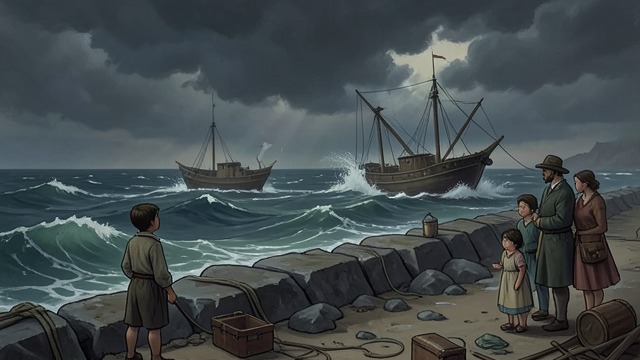
A Childhood at the Breakwater
Waiting for boats
As a child, Quart watches fishing boats struggle home through a storm. One boat fails to return, and the waiting families learn that loss does not follow a human plan.
A rule born from grief
Quart concludes that prayer cannot command the sea and resolves that no one will wait for him at a breakwater. The childhood decision becomes the beginning of his controlled solitude.
A Templar against the Void

A Templar against the Void
The chosen image
Quart imagines himself as a solitary Templar in a desert, supported by discipline when belief fails. The image gives heroic form to his professional endurance.
The limits of self-control
His past missions leave him with guilt and memories of the dead. The Templar image can organize his life but cannot make the consequences disappear.
Stars beyond Human Measure

Stars beyond Human Measure
Astronomical time
Ferro explains that the light of stars reaches Earth long after it began its journey. Some visible stars may already have died, while their light still guides observers.
Human uncertainty
The conversation makes Quart feel the smallness of human concerns. The church dispute and the Roman report appear insignificant against a universe that continues without witness.
A Hand before the End
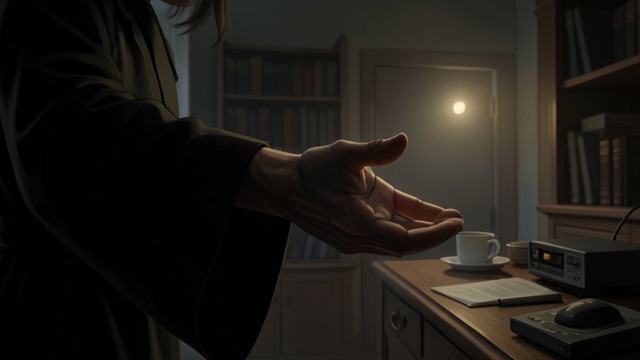
A Hand before the End
A counterweight to despair
Ferro does not answer cosmic indifference with a claim of certainty. He points instead to the value of a friendly hand that offers consolation before life ends.
Meaning in the finite
His view reframes the parish’s work as valuable precisely because it is brief. A ritual or kindness may not change the universe, but it can change a person’s final experience.
A Small Victory at Dawn
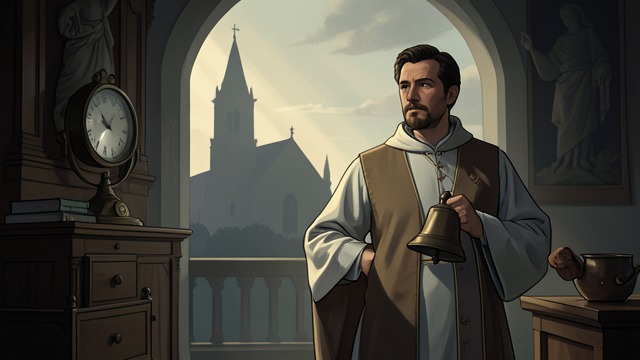
A Small Victory at Dawn
Waiting in the church
Quart spends the night outside the church and enters at dawn. He cannot offer a confident prayer, but he waits in the space where the parish’s rituals have given people shelter.
Continuing the service
He dresses for Mass and rings the bell. The action is not a triumph over death or institutional power; it is a limited act that keeps consolation available for another morning.
Quart’s childhood, before his seminary years
during Quart’s adult service before the Seville mission
the evening of the observatory conversation
at the end of Ferro’s reflection on the stars
the dawn after Quart delivers Ferro to police
